

ISO 9001:2026 for PCB Suppliers: What Buyers Should Verify Now
Should PCB buyers reject a supplier whose certificate still references ISO 9001:2015? No. ISO 9001:2026 was published on September 16, 2026, but ISO says organizations certified to the 2015 edition have a three-year transition period; buyers should verify that the current certificate is valid and relevant, then assess the supplier’s transition plan and order-specific controls.
The key purchasing decision is not whether the certificate already shows “2026.” It is whether the supplier can demonstrate a controlled quality system for the facility, processes and products in your sourcing scope, while managing the standards transition without weakening production control.
What changed on September 16, 2026?
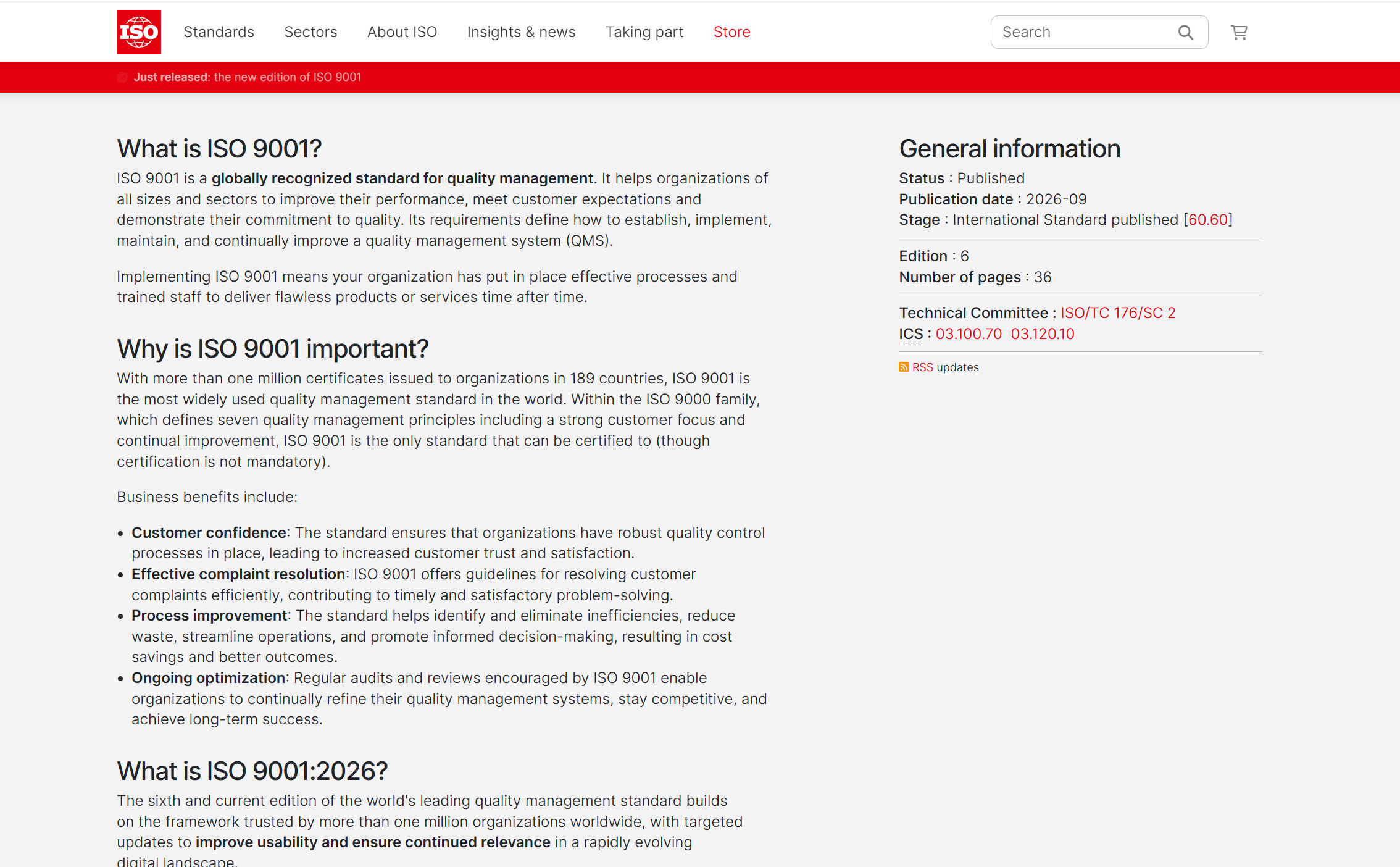
ISO published ISO 9001:2026 as the sixth and current edition of its quality management system requirements standard on September 16, 2026. The new edition replaces ISO 9001:2015.
ISO describes the revision as a targeted update rather than a complete redesign. Its public guidance highlights stronger attention to leadership, quality culture, ethical behavior, alignment between quality policy and business strategy, clearer treatment of risks and opportunities, employee awareness, and a new Annex A that explains concepts and intent. ISO also says the Harmonized Structure remains in place.
These are external facts published by ISO. They do not, by themselves, prove that any individual PCB factory has completed a transition or that a specific production lot meets a buyer’s technical requirements.
Source: https://www.iso.org/quality-management/iso-9001-2026
Source: https://www.iso.org/standard/9001
Is an ISO 9001:2015 certificate immediately obsolete?
No. ISO’s public transition guidance says organizations already certified to ISO 9001:2015 have three years to move to ISO 9001:2026 and should agree a transition plan with their certification body.
The United Kingdom Accreditation Service published a revised technical bulletin on October 7, 2026. For certification under its accreditation system, the bulletin states that conformity assessment bodies must transition all certified customers by September 30, 2029. It also warns that certification issued against ISO 9001:2026 before the relevant certification body receives an accreditation transition decision must not be represented as accredited certification.
That detail matters for supplier qualification. A certificate carrying the new year is not automatically stronger if the accreditation chain is unclear, while a valid 2015 certificate can remain legitimate during the transition period. Buyers should check the certificate, the certification body and the accreditation status instead of screening by edition number alone.
Source: https://www.ukas.com/resources/technical-bulletins/qms-iso-9001-2026-transition/
What should a PCB or PCBA buyer verify now?
Use the following checks for new supplier approval, annual review, high-risk builds and any RFQ that names ISO 9001 as a requirement.
1. Verify the legal entity name
The name on the certificate should match the contracting and manufacturing entity involved in the order. If an affiliated company, sales office or different factory will perform work, ask how that entity and site are covered.
2. Verify the manufacturing-site address
A group certificate or head-office certificate does not automatically show that every production location is covered. Confirm that the PCB fabrication or PCBA assembly site named in the purchase plan appears within the certified scope or an approved multisite schedule.
3. Read the certified scope
The scope should be relevant to the work being purchased. A broad quality-management statement is not a substitute for confirming that printed circuit board fabrication, electronic assembly or the applicable manufacturing activity is included.
4. Check issue, expiry and status information
Record the certificate number, issue date, expiry date and certification body. Where possible, verify the certificate through the certification body’s directory or another recognized certificate-status service. Request written clarification if any detail is missing or inconsistent.
5. Check the accreditation chain
Identify the certification body and the accreditation body shown on the certificate. Confirm that the certification body is accredited for the relevant management-system certification activity and territory. Do not assume that a logo alone proves current accredited status.
6. Ask for a dated ISO 9001:2026 transition plan
The supplier should be able to state who owns the transition, when its gap analysis will be completed, when procedures and training will be updated, when internal audits and management review will address the new edition, and when the certification-body audit is expected. Buyers do not need to demand immediate recertification, but an undated promise is not a useful control.
7. Define notification duties
The quality agreement or purchase terms should require timely notice of certificate suspension, withdrawal, scope reduction, site removal, certification-body change or a missed transition milestone. The notice period and escalation path should be explicit.
8. Audit order-level controls
ISO 9001 is a management-system standard, not a product acceptance certificate. A buyer still needs technical controls tied to the build, such as released Gerber and drill data, approved stackup, controlled material callouts, impedance requirements, surface finish, solder-mask and legend requirements, inspection criteria, test coverage, traceability, change approval and nonconformance handling.
9. Apply risk-based depth
The evidence required for a simple prototype need not be identical to the evidence required for a safety-related, automotive, medical, aerospace or high-reliability assembly. Match the audit depth, records, sampling and approval gates to product risk, regulatory obligations and the cost of failure.
10. Keep sector requirements separate
ISO 9001 does not replace product specifications, customer drawings, IPC acceptance criteria, regulatory obligations or sector-specific quality-system requirements. If a program requires IATF 16949, ISO 13485, AS9100 or another scheme, evaluate that requirement independently and confirm its exact scope.
How the 2026 changes can improve a PCB supplier audit
The revised edition gives buyers useful topics for process-based questions. The following are procurement applications, not direct quotations from the standard.
Leadership and quality culture
Ask how management responds when shipment pressure conflicts with inspection, testing or material-control requirements. Review whether operators can stop work, how escapes are escalated, and whether corrective actions address system causes rather than only sorting suspect product.
Ethical behavior
Ask how the supplier prevents altered inspection records, unauthorized material substitution, hidden rework and unsupported conformity statements. Review approval permissions, record integrity, segregation of nonconforming material and escalation channels.
Risks and opportunities
Ask the supplier to connect risk review to the actual order. Relevant examples may include a sole-source laminate, unusually tight registration, controlled impedance, fine-pitch assembly, moisture-sensitive components, obsolescence, counterfeit-part exposure, tooling transfer or a compressed schedule. Then verify the mitigation owner and evidence.
Planning of changes
Clarify which changes require buyer approval before implementation. Depending on the order, this may include material manufacturer or grade, stackup, copper weight, surface finish chemistry, production site, subcontracted process, assembly source, test method, panelization or process route.
People and awareness
Check whether personnel performing special or critical work have current competence evidence. For a PCB or PCBA order, this may involve CAM review, impedance planning, microsection inspection, soldering, automated optical inspection review, rework, electrical test or final release.
Management review and performance evidence
Request trend data that matters to the sourcing decision. Useful indicators may include on-time delivery, first-pass yield, customer complaints, escapes, corrective-action closure time and recurring defect categories. Agree on definitions before comparing numbers across suppliers.
What to request before the next purchase order
A practical evidence pack can include the following items:
1. Current quality-management certificate and all pages or site schedules
2. Certification-body and accreditation details that can be independently checked
3. A dated ISO 9001:2026 transition plan with an accountable owner
4. Confirmation of the manufacturing site and any outsourced special processes
5. A contract review record for the board or assembly requirements
6. The approved material, stackup and surface-finish controls relevant to the build
7. The inspection and test plan, including acceptance criteria and retained records
8. Traceability expectations for materials, lots, work orders and components
9. The change-notification and buyer-approval process
10. The nonconformance, deviation, corrective-action and containment process
11. The agreed quality metrics and review frequency
12. A rule for notifying the buyer of certification-status changes
This list should be scaled to the product and contract. It is not a universal demand for disclosure of a supplier’s confidential quality manual or every internal record.
What JETFGO currently states publicly
JETFGO’s English company profile states that the company produces prototypes and small- and medium-batch printed circuit boards and lists ISO 9001:2015 among its certifications. Its English website also presents conventional, high-frequency, high-speed, hybrid, HDI, flex-rigid and special-technology board categories, along with process-capability and contact pages.
Those statements are JETFGO’s own published website information. This article does not independently certify their current status, expand their scope or claim that JETFGO has completed transition to ISO 9001:2026. A buyer should request the current certificate, scope, site coverage and build-specific evidence during qualification or RFQ review.
JETFGO company profile: https://www.jetfgo.com/en/company-profile.html
JETFGO process capability: https://www.jetfgo.com/en/capability
JETFGO product center: https://www.jetfgo.com/en/products.html
JETFGO contact page: https://www.jetfgo.com/en/contact
Questions to include in a PCB or PCBA RFQ
Add concise questions that produce verifiable answers:
1. Which legal entity and production site will manufacture this order?
2. Does your current ISO 9001 certificate cover that entity, site and activity?
3. Which certification and accreditation bodies support the certificate?
4. What is the certificate’s current status and expiry date?
5. What is your target date for transition to ISO 9001:2026?
6. Which material, process or site changes require our written approval?
7. What inspection, test and traceability records will ship with or remain available for this order?
8. How will you notify us of a certification suspension, withdrawal, scope change or transition delay?
9. Which acceptance standard and class will govern the PCB or PCBA, and which revision applies?
10. How will deviations and nonconforming product be contained, approved and closed?
Frequently asked questions
Does ISO 9001:2026 replace ISO 9001:2015?
Yes. ISO identifies the 2026 edition as the current edition. Existing certified organizations are given a transition period rather than being expected to replace their certificates on the publication date.
Must a PCB supplier already hold an ISO 9001:2026 certificate in October 2026?
Not solely because the new edition has been published. Buyers should verify the validity and relevance of the supplier’s current certification and obtain a credible transition plan. Contractual or regulatory requirements may impose additional conditions.
Does ISO 9001 certification prove that a PCB lot will meet the drawing?
No. Certification supports confidence in the supplier’s quality management system. Product conformity still depends on accurate specifications, contract review, controlled manufacturing, inspection, testing, traceability and acceptance evidence for the particular order.
Should buyers set September 30, 2029 as a contract deadline?
Treat that date as an important published transition milestone, not as a substitute for checking the certification body’s instructions and the applicable accreditation program. If certification is contractually required, define the required edition, acceptable transition evidence and notification duties in writing.
What is the best action for buyers today?
Do not use the year printed on a certificate as a one-factor pass or fail decision. Verify certificate identity, scope, site and accreditation; request the supplier’s ISO 9001:2026 transition plan; and keep the purchasing decision anchored to the technical and quality evidence required for the actual PCB or PCBA build.
If you are evaluating a prototype or small- to medium-batch PCB project, review JETFGO’s published product categories and process information, then use the contact page to request current certification and build-specific capability evidence for your RFQ.