
Percorso a materiali misti per usare prestazioni RF solo dove servono. Finestra di processo verificata: Materials: FR-4 families + Rogers RO4003C / RO4350; Thickness range: Rigid PCB 0.3–8.0 mm; Impedance tolerance: ±8% File per la revisione: Gerber o ODB++, file di foratura, stack-up, disegno, quantità e data richiesta. I limiti pubblicati derivano dall’attuale tabella capacità JETFGO; la fattibilità finale richiede i dati completi.
I limiti pubblicati derivano dall’attuale tabella capacità JETFGO; la fattibilità finale richiede i dati completi.Codice soluzioneHYB-RFCapacità verificata
PCB ibrido FR-4 + Rogers
Percorso a materiali misti per usare prestazioni RF solo dove servono.
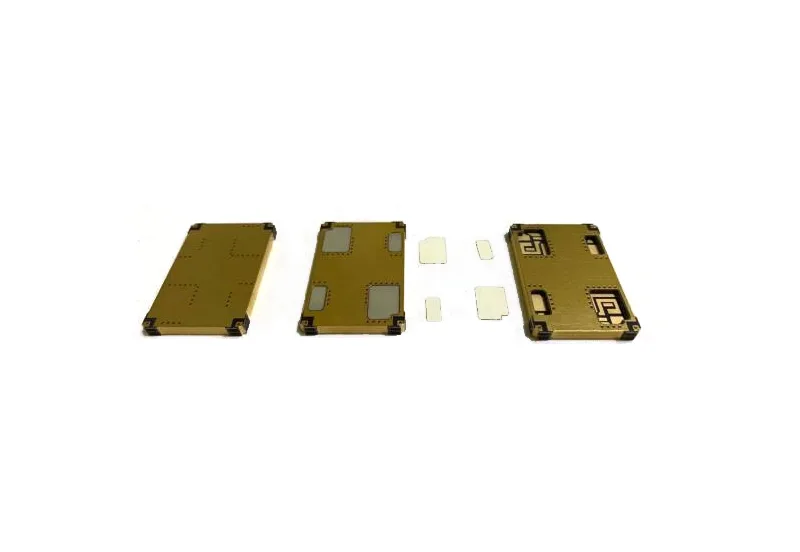
JETFGO / HYB-RFRIGID
01 / RISPOSTA TECNICA
Risposta tecnica
02 / DATA
Finestra di processo verificata
Percorso a materiali misti per usare prestazioni RF solo dove servono.
Material Combination
FR-4 families + Rogers RO4003C / RO4350B
Thickness Range
Rigid PCB 0.3–8.0 mm
Impedance Tolerance
±8%
Hybrid Stack-up Review
Rogers layers · FR-4 layers · dielectric · copper · impedance
Rogers Material Options
RO4003C · RO4350B, subject to project and material review
05 / INPUT
File per la revisione
Hybrid PCB Engineering Package
Gerber or ODB++, drill files, proposed stack-up, fabrication drawing, quantity, target delivery date, Rogers material requirement and applicable controlled-impedance specifications.
Hybrid Material & Stack-up Requirements
Specify the Rogers laminate, FR-4 material family, layer sequence, dielectric thicknesses, copper weights and any restrictions on material substitution.
RF Impedance Requirements
Provide target impedance, tolerance, routing layer, reference plane and applicable microstrip, stripline or differential transmission-line requirements.
Critical RF Layer Information
Richiedi un preventivoIdentify the RF routing layers, antenna or microwave sections and other signal structures that require Rogers material or specific dielectric control.
06 / FAQ
Domande tecniche
I limiti pubblicati derivano dall’attuale tabella capacità JETFGO; la fattibilità finale richiede i dati completi.
01Why combine Rogers laminate with FR-4 in a hybrid PCB?+
A hybrid construction can place Rogers high-frequency material in RF-critical layers while using FR-4 for digital, control or less frequency-sensitive sections. This can balance electrical performance, multilayer integration and manufacturing cost.
02Which files help JETFGO review an FR-4 + Rogers hybrid PCB fastest?+
Send Gerber or ODB++, drill files, proposed stack-up, fabrication drawing, quantity, target delivery date, required Rogers laminate and all controlled-impedance requirements.
03Can JETFGO support prototypes and repeat production for Rogers hybrid PCBs?+
Yes. Once the hybrid stack-up, Rogers and FR-4 materials, impedance requirements and lamination conditions are confirmed, the approved engineering record can support prototype validation and repeat production.
04Can RO4003C or RO4350B be combined with FR-4 in the same PCB?+
Yes, mixed-material constructions using Rogers high-frequency laminates and FR-4 can be evaluated. Final feasibility depends on the complete stack-up, material thicknesses, copper structure, lamination requirements and project-specific DFM review.
05What is the difference between a Rogers hybrid PCB and a full Rogers PCB?+
A full Rogers PCB uses high-frequency laminate across the relevant board construction, while a hybrid PCB combines Rogers material with FR-4 so that high-frequency laminate is used only where the electrical design requires it.
06What information is required for impedance control on a hybrid RF PCB?+
Provide the target impedance, tolerance, routing layer, reference plane, Rogers laminate and thickness, FR-4 stack-up information, copper requirements and relevant transmission-line geometry whenever available.
07Can Rogers material be substituted without customer approval?+
Material substitution should not be assumed for RF designs. Any change to the Rogers laminate, dielectric thickness or other electrically significant material should be reviewed against the approved stack-up and customer requirements before production.
RFQ / DFM
Invia il requisito. Ricevi un piano di fornitura producibile.
Invia Gerber o ODB++, stackup, materiali, quantità, data richiesta e test per la verifica tecnica e il preventivo.
Revisione tecnicaMateriali e stack-upFabbricazione