
Voie métal-core lorsque le transfert thermique guide la conception. Fenêtre de procédé vérifiée: Material family: Metal core: BOYU; Rigid thickness: 0.3–8.0 mm; Routing: Routing · punching · V-cut · beveling Fichiers pour la revue: Gerber ou ODB++, perçage, empilage, plan de fabrication, quantité et date cible. Les limites publiées proviennent de la matrice de capacités JETFGO. La faisabilité finale exige le dossier complet.
Les limites publiées proviennent de la matrice de capacités JETFGO. La faisabilité finale exige le dossier complet.Code solutionMCPCB-ALCapacité vérifiée
PCB LED à noyau aluminium
Voie métal-core lorsque le transfert thermique guide la conception.
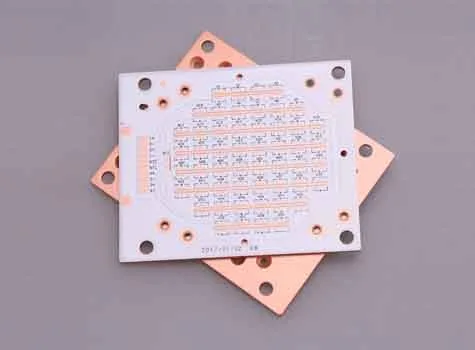
JETFGO / MCPCB-ALMETAL-CORE
01 / RÉPONSE TECHNIQUE
Réponse technique
02 / DATA
Fenêtre de procédé vérifiée
Voie métal-core lorsque le transfert thermique guide la conception.
Aluminum-Core Material
BOYU aluminum-base laminate
PCB Thickness Range
0.3–8.0 mm
Profiling Options
Routing · punching · V-cut · beveling
Thermal-Path Review
Aluminum core · dielectric layer · copper · LED heat path
LED Application Review
Thermal pads · component heat zones · mounting · board outline
Engineering Review
Material · dielectric · thickness · thermal · mechanical requirements
05 / INPUT
Fichiers pour la revue
Aluminum PCB Engineering Package
Gerber or ODB++, drill files, proposed stack-up, fabrication drawing, quantity, target delivery date and any aluminum-core, thermal, dielectric or mechanical requirements.
Thermal Requirements
Provide heat-source locations, thermal-management requirements and any specified dielectric thermal performance or aluminum-core material requirements.
Material & Stack-up Requirements
Provide aluminum-core material, board thickness, copper requirements, dielectric structure and any approved material or construction restrictions.
Mechanical & Profiling Requirements
Provide final board outline, mounting holes and any routing, punching, V-cut, beveling or mechanical tolerance requirements.
LED Assembly Requirements
Demander un devisIdentify LED locations, thermal-pad areas, component mounting interfaces and any assembly constraints that may affect heat transfer or board construction.
06 / FAQ
Questions techniques
Les limites publiées proviennent de la matrice de capacités JETFGO. La faisabilité finale exige le dossier complet.
01What is an aluminum-core LED PCB?+
An aluminum-core LED PCB is a metal-base circuit board that uses an aluminum base, dielectric layer and copper circuitry to transfer heat away from LEDs and other heat-generating components more efficiently than a conventional PCB construction.
02Which files help JETFGO review an aluminum-core LED PCB fastest?+
Send Gerber or ODB++, drill files, proposed stack-up, fabrication drawing, quantity, target delivery date and any aluminum-core, thermal, dielectric, copper or mechanical requirements.
03Can JETFGO support prototypes and repeat production for aluminum LED PCBs?+
Yes. Once the aluminum-core material, dielectric structure, copper requirements, thickness and mechanical construction are confirmed, the approved engineering record can support prototype validation and repeat production.
04Why is aluminum used for LED PCBs?+
Aluminum provides a metal base that helps transfer heat away from LEDs through the dielectric and copper structure into the surrounding thermal assembly. This makes it useful for lighting and other heat-intensive electronics.
05What is the difference between an aluminum PCB and an FR-4 PCB?+
An aluminum PCB includes a metal base designed to support heat transfer, while a conventional FR-4 PCB uses a fiberglass-reinforced laminate structure. Material selection depends on thermal, electrical, mechanical and cost requirements.
06Does the aluminum core alone determine LED PCB thermal performance?+
No. Thermal performance also depends on the dielectric layer, copper structure, component thermal pads, board thickness, heat-source layout and the thermal connection between the PCB and final assembly.
07Which profiling methods are available for aluminum-core PCBs?+
JETFGO can review aluminum-core PCB projects requiring routing, punching, V-cut or beveling. Final profiling method depends on board thickness, outline, panel structure and mechanical requirements.
08Can aluminum-core PCBs be used for high-power LEDs?+
Yes, aluminum-core PCBs are commonly evaluated for high-power LED applications where heat transfer is a major design requirement. Final suitability depends on LED power, dielectric performance, copper design, board structure and the complete thermal path.
RFQ / DFM
Envoyez le besoin. Recevez un plan d’approvisionnement fabricable.
Envoyez Gerber ou ODB++, empilage, matériaux, quantité, date cible et tests pour étude et devis technique.
Revue techniqueMatériaux et empilageFabrication précise