
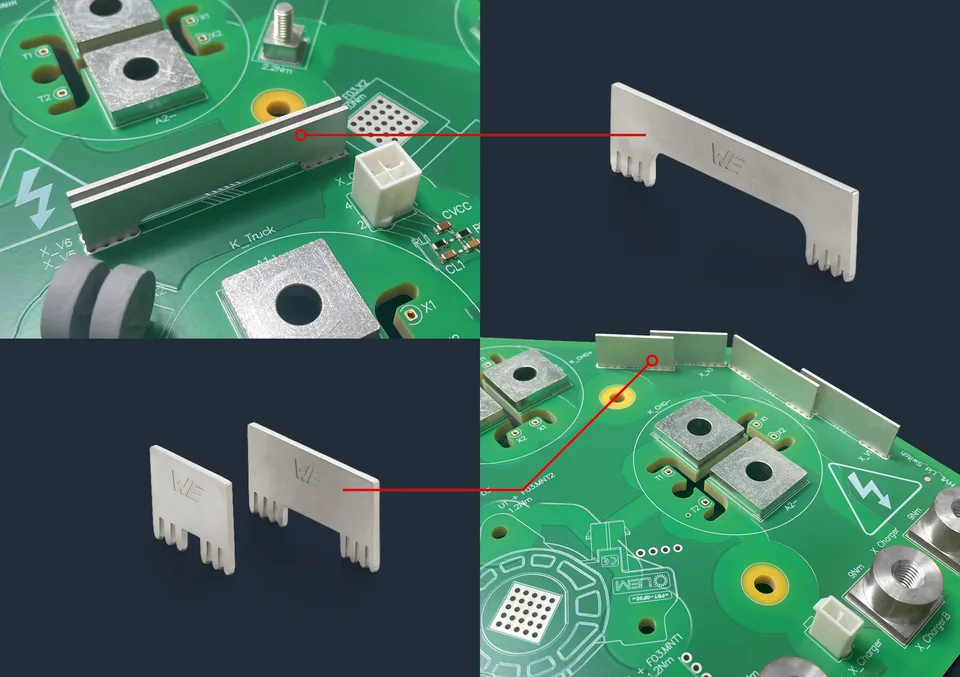
TL;DR Würth Elektronik ICS presented its PowerBusbar PF on a press-release page published November 2, 2026, with an October 29 dateline in the release text. For a design that needs extra copper only along specific high-current paths, a vertical busbar may offer an alternative to a heavy-copper PCB. The decision depends on the actual current and thermal design, plated-hole specification, insertion process and total assembled cost.
What Würth presented
PowerBusbar PF is pressed vertically into a PCB and can serve as a current path or bridge. Würth lists four standard lengths, from 19 to 59 mm, each 18.4 mm high and 1.2 mm thick. Its announcement says a standard FR-4 board can replace a specialized heavy-copper or copper-inlay board in some applications; it does not establish that substitution for every design.
What changes for a PCB buyer
Moving copper from the board into a separate part changes the fabrication and assembly requirements together. Würth’s version 1.0 product overview specifies an FR-4 board at least 1.5 mm thick, a press-in force of 60–250 N per pin and a press-in speed of 100–250 mm/min. It also calls for board support, force applied at 90 degrees and plated holes made to Würth’s press-fit specification. These are PowerBusbar PF requirements, not general limits for all press-fit parts.
How to decide
First, request the current manufacturer drawing and press-fit specification for the exact busbar size. Have the board fabricator confirm the drill, hole copper, finish, annular ring and tolerances before releasing the PCB data.
Next, compare complete options: heavy-copper board fabrication versus a suitable board plus busbars, insertion tooling, assembly steps and inspection. Würth’s statement about possible material savings is not a project quotation or a guaranteed saving.
Finally, test the proposed assembly at its real current, ambient temperature and duty cycle. Check temperature rise, electrical clearance, insertion and retention results, and the reliability requirements of the end product before approving the change.
JETFGO’s published PCB manufacturing capabilities describe copper-dependent process limits and engineering review. That page is a starting point for checking board feasibility; it does not state that JETFGO offers PowerBusbar PF insertion or that a particular design can use a standard board.
References Würth Elektronik ICS, “Vertical busbars enable high currents on standard PCBs,” webpage dated November 2, 2026; release text datelined October 29, 2026: https://www.we-online.com/en/news-center/press/press-releases?d=vertical-busbars-high-current-standard-pcbs Würth Elektronik ICS, “PowerBusbar PF” product overview, version 1.0, undated: https://www.we-online.com/files/pdf1/we-ics-data-sheet-powerbusbar-pf-en.pdf
Related JETFGO pages PCB manufacturing capabilities: https://jetfgo.online/en/capabilities